Foundational guide
Retatrutide Results: What the Phase 3 TRIUMPH Trials Report
Four phase 3 readouts, one peer-reviewed paper and a headline number that changes with the analysis method. Here is how to read them.
Retatrutide results from the phase 3 TRIUMPH programme show mean weight loss of roughly 19 to 29 percent in adults with obesity, depending on the trial, the dose, the length of follow up and the way the number is calculated. At 80 weeks in TRIUMPH-1, the 12 mg dose produced 28.3 percent on one analysis and 25.0 percent on another. Retatrutide is still investigational and is approved nowhere.

This page is a reading guide for those results. It sets out which numbers come from a peer-reviewed paper and which from company press releases, why one trial yields two headline figures, and what the trials have not yet shown. Dosing, side effects and the mechanism are covered in what is retatrutide and the side effects guide.
Where the TRIUMPH programme stands on 5 November 2026
The first evidence in humans came from a phase 2 trial published in the New England Journal of Medicine in 2023 (Jastreboff et al.), which reported roughly 24 percent mean weight loss at 48 weeks on the 12 mg dose. Phase 3 has now reported four registration trials, all sponsored by Eli Lilly and all announced first by topline press release.
- TRIUMPH-4 (NCT05869903), adults with obesity and knee osteoarthritis, announced 11 December 2025.
- TRIUMPH-1 (NCT05929066), adults with obesity or overweight, announced 21 May 2026 and since published in the New England Journal of Medicine.
- TRIUMPH-2 (NCT05929079), adults with type 2 diabetes and obesity or overweight, and TRIUMPH-3 (NCT05882045), adults with severe obesity and established cardiovascular disease, announced together on 23 July 2026.
On regulatory status, Lilly’s July release says the company is completing the chemistry, manufacturing and controls package and plans to submit a Biologics License Application to the FDA in the first quarter of 2027. No submission, approval or brand name was found in the sources checked for this page. Lilly’s own releases describe the drug as legally available only to participants in its clinical trials.
Retatrutide results by trial
The table gives the mean percentage change in body weight on the efficacy estimand, which is the figure each press release led with. TRIUMPH-1 to 3 ran 80 weeks and TRIUMPH-4 ran 68 weeks. TRIUMPH-3 tested only the two higher doses.
| Trial and population | 4 mg | 9 mg | 12 mg | Placebo |
|---|---|---|---|---|
| TRIUMPH-1, obesity or overweight (n = 2,339) | -19.0% | -25.9% | -28.3% | -2.2% |
| TRIUMPH-2, type 2 diabetes (n = 1,152) | -12.7% | -19.1% | -20.8% | -4.0% |
| TRIUMPH-3, severe obesity with cardiovascular disease (n = 1,949) | Not tested | -21.6% | -22.6% | -3.2% |
| TRIUMPH-4, obesity with knee osteoarthritis (n = 445, 68 weeks) | Not tested | -26.4% | -28.7% | -2.1% |
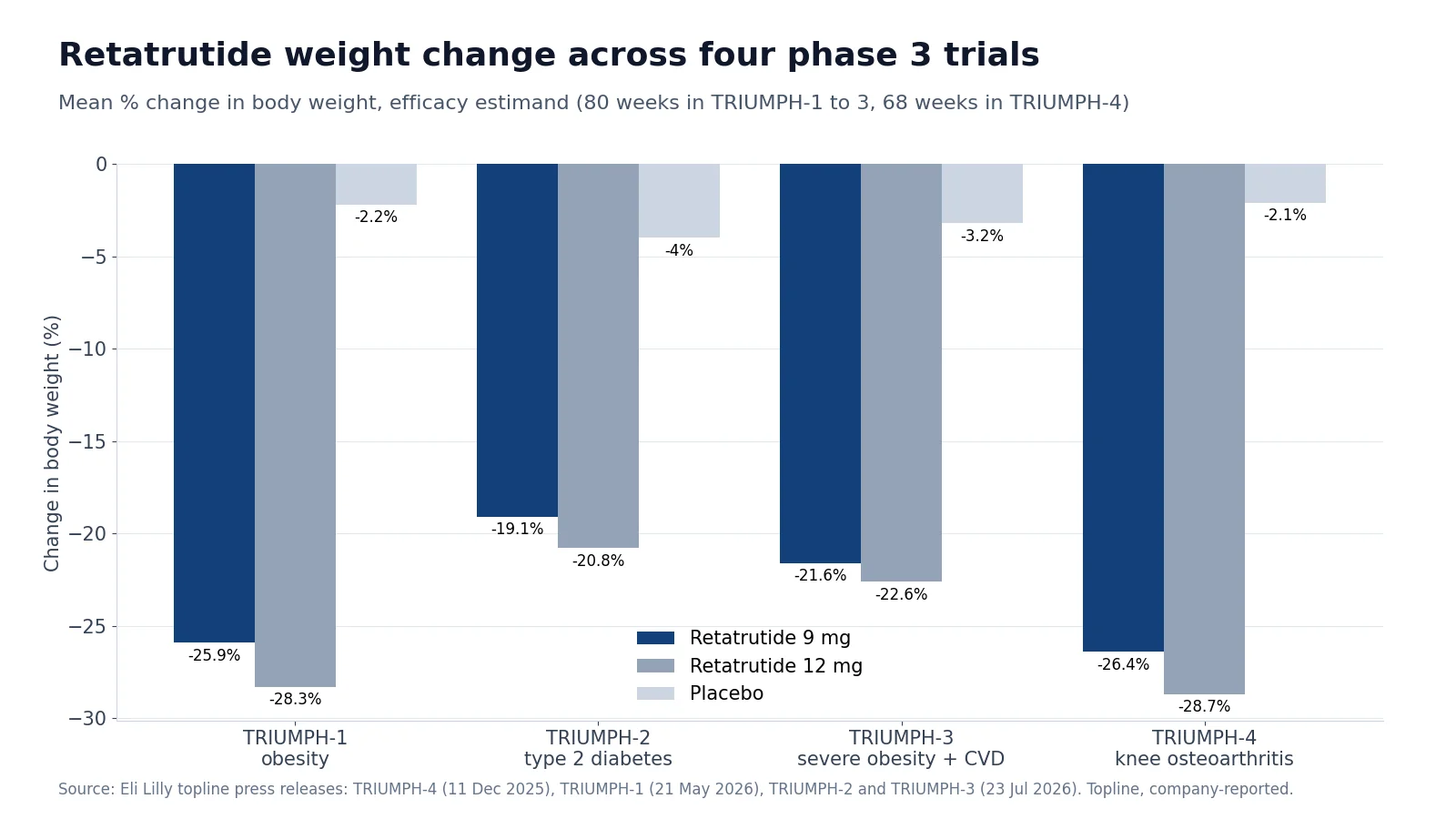
Source: Eli Lilly topline press releases of 11 December 2025, 21 May 2026 and 23 July 2026. Company-reported.
Two patterns matter. Weight loss is dose related but flattens between 9 and 12 mg, and it is smaller in the type 2 diabetes population than in people without diabetes. That second pattern is consistent with what has been seen across the incretin class and is a property of the population, not a defect in the molecule.
Why TRIUMPH-1 has two headline numbers
Lilly’s May release reported 28.3 percent at 12 mg. The New England Journal of Medicine paper’s primary result for the same dose is 25.0 percent, with placebo at 3.9 percent rather than 2.2. Nothing was corrected. The two figures answer different questions, and the difference is an estimand.
The efficacy estimand asks what happens in participants who stay on treatment as intended, so it excludes the effect of stopping the drug. The treatment-regimen estimand asks what happens to everyone randomised, including people who stopped or switched, and is the more conservative real-world reading. Neither is wrong. A reader comparing retatrutide with another drug has to compare like with like, and a trial that reports only one estimand cannot be set against one that reports the other. See the endpoints guide for the general method.
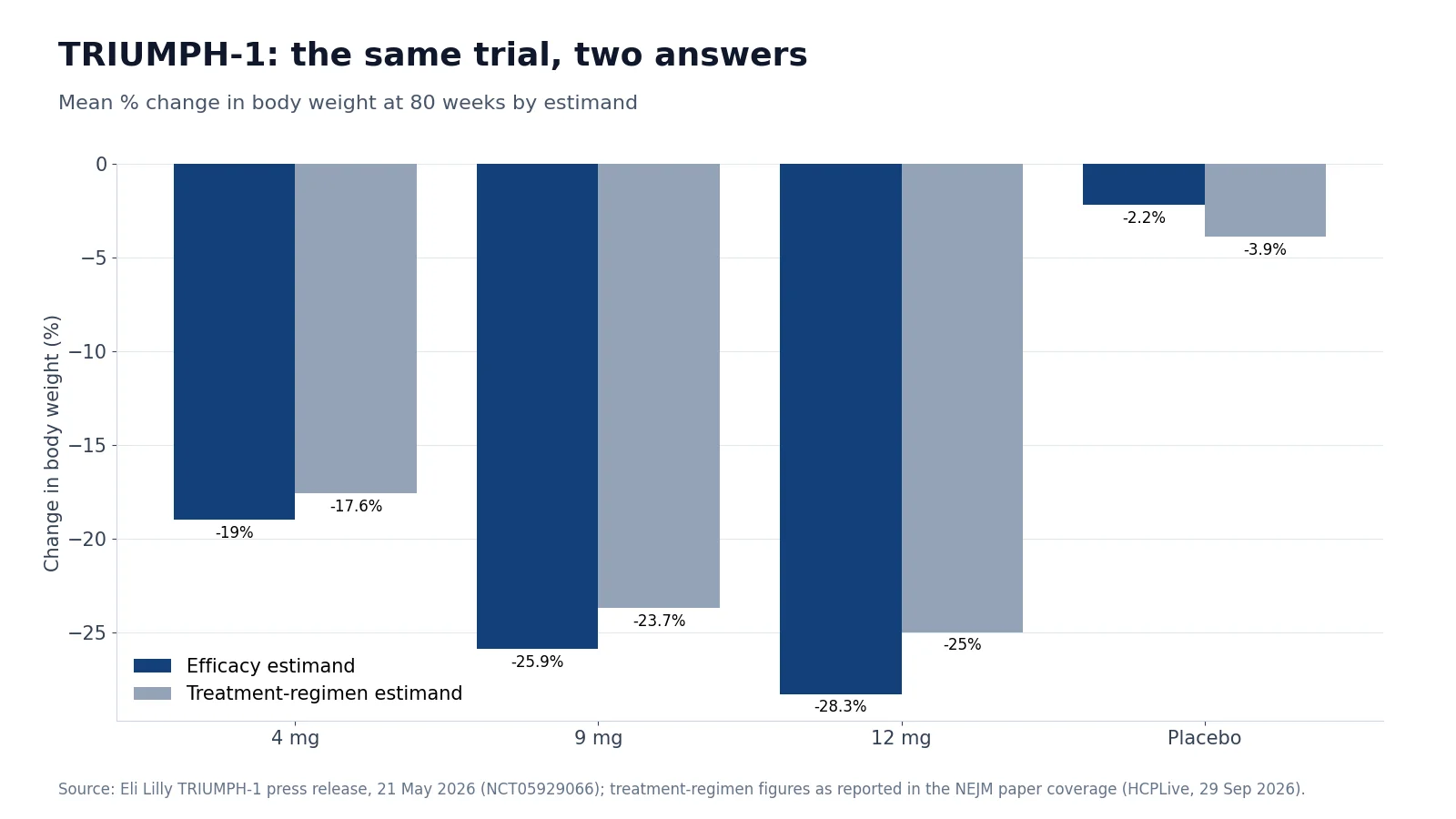
Source: Eli Lilly TRIUMPH-1 release (21 May 2026); treatment-regimen values as reported in coverage of the NEJM paper (HCPLive, 29 September 2026).
Note the placebo direction. Under the treatment-regimen estimand the placebo arm shows more weight loss (3.9 percent) than under the efficacy estimand (2.2 percent), because participants who stopped assigned treatment are still counted, which narrows the gap. The between-group difference at 12 mg in the paper is 21.0 percentage points.
Beyond body weight: pain, glucose and sleep apnoea
TRIUMPH-4 reported WOMAC knee pain falling by about 4.4 to 4.5 points on a baseline of 6.0 at 9 and 12 mg, against 2.4 on placebo, on the efficacy estimand. Lilly states the percentage pain reductions were not pre-specified and come from a post hoc analysis.
In TRIUMPH-2, A1C fell by 1.4, 1.6 and 1.5 percentage points at 4, 9 and 12 mg from a baseline of 7.7 percent, against 0.2 on placebo. The peer-reviewed TRIUMPH-1 paper, as summarised in trade coverage, reports knee pain changes of 3.2, 3.5 and 3.6 points against 1.9 on placebo in its osteoarthritis basket, and falls in apnoea-hypopnoea events per hour of 22.9, 34.3 and 31.7 against 9.9 on placebo in its sleep apnoea basket. Those baskets were sub-populations, not the whole trial.
In TRIUMPH-3, cardiovascular events were rare. Lilly reported 27 major adverse cardiovascular events on retatrutide against 23 on placebo, a hazard ratio of 1.12 with a 95 percent confidence interval of 0.64 to 1.96. That interval spans no effect in either direction, so the trial neither shows protection nor shows harm. It was not powered to.
Adverse events and discontinuations
Gastrointestinal effects led the adverse event lists, rising with dose, as with the other incretin drugs. One finding is specific enough to flag: dysesthesia, an abnormal skin sensation such as burning or tingling, was reported far more often on retatrutide than on placebo. Lilly describes the events as generally mild and rarely leading to discontinuation.
| Measure | Trial | 9 mg | 12 mg | Placebo |
|---|---|---|---|---|
| Nausea | TRIUMPH-1 | 38.4% | 42.4% | 14.8% |
| Dysesthesia | TRIUMPH-1 | 12.3% | 12.5% | 0.9% |
| Dysesthesia | TRIUMPH-4 | 8.8% | 20.9% | 0.7% |
| Stopped for adverse events | TRIUMPH-1 | 6.9% | 11.3% | 4.9% |
| Stopped for adverse events | TRIUMPH-4 | 12.2% | 18.2% | 4.0% |
The discontinuation gap is part of the result. At 12 mg, 11.3 to 18.2 percent of participants stopped for adverse events in these two trials, against 4.0 to 4.9 percent on placebo, so the efficacy-estimand weight loss belongs to the people who tolerated the drug. For more on tolerability see the retatrutide side effects page.
What the results do not show
Trial figures attach to a specific object: a pharmaceutical product of verified identity and concentration, titrated on a protocol and monitored. They say nothing about a vial whose contents nobody has tested. The only way to learn what a particular vial holds is batch-specific analysis, covering identity by mass spectrometry, purity by HPLC and endotoxin testing, which no trial result substitutes for. The same caution applies to anecdotal accounts of before and after outcomes, which carry none of the controls the trials had.
The results also leave open how long the effect lasts after stopping, long-term safety beyond about 80 weeks, performance in head-to-head comparison with approved drugs, and detailed peer-reviewed data for three of the four trials. Readers who want to know where unapproved material is being sold and discussed can consult Retatrutide for sale listings with the same scepticism applied to any unverified claim, since none of these sellers is part of Lilly’s supply chain.
How this evidence grades
The weight-loss result in TRIUMPH-1 is top-tier evidence: a randomised, double-blind, placebo-controlled trial published in a leading journal. The other three trials sit one step lower for now, as registered and sponsor-reported but not yet independently reviewed in the sources checked. The conclusion is not in doubt, since the effect sizes are large and consistent across four populations. The uncertainty is about durability, rare harms and how the drug compares with approved alternatives.
Frequently asked questions
- What are the headline retatrutide results?
- In the TRIUMPH-1 obesity trial, Lilly reported mean weight loss of 28.3 percent at 12 mg after 80 weeks on the efficacy estimand, against 2.2 percent on placebo. The peer-reviewed paper reports 25.0 percent for the same dose on the treatment-regimen estimand, against 3.9 percent on placebo. Both figures describe the same trial.
- Are the TRIUMPH results peer reviewed?
- TRIUMPH-1 has been published in the New England Journal of Medicine. The TRIUMPH-2, TRIUMPH-3 and TRIUMPH-4 numbers on this page come from company topline press releases, which Lilly says will be followed by presentation and peer-reviewed publication.
- Is retatrutide approved by the FDA?
- No. As of 5 November 2026 retatrutide has no marketing authorisation. Lilly has said it is completing the manufacturing data package and plans to submit a Biologics License Application to the FDA in the first quarter of 2027. No brand name has been announced in the sources reviewed.
- What did the trials show for people with type 2 diabetes?
- TRIUMPH-2 enrolled adults with type 2 diabetes and obesity or overweight. Lilly reported mean weight loss of 12.7, 19.1 and 20.8 percent at 4, 9 and 12 mg after 80 weeks, against 4.0 percent on placebo, with A1C falling by 1.4, 1.6 and 1.5 percentage points against 0.2 on placebo.
- Do the trial results apply to vials sold online?
- Only if the vial contains the same compound at the stated dose and purity, which a label cannot establish. The results belong to a pharmaceutical trial product administered under protocol, with monitoring, dose escalation and medical oversight.
Limitations of the evidence
This page was checked on 5 November 2026. The phase 3 figures for TRIUMPH-1, TRIUMPH-2, TRIUMPH-3 and TRIUMPH-4 come from Eli Lilly topline press releases, which are company-reported and were not peer reviewed when issued; the TRIUMPH-1 treatment-regimen figures and bibliographic details of the NEJM paper were taken from trade-press coverage of that paper because the journal page could not be opened for this review. Detailed TRIUMPH-2, TRIUMPH-3 and TRIUMPH-4 data had not been confirmed as peer reviewed at the time of writing. Group means describe the trial populations at one timepoint under supervised conditions with verified drug supply, and they do not predict any individual outcome. Retatrutide is investigational, no regulator has approved it, and Lilly has stated it plans a US submission in the first quarter of 2027. The contents of any vial sold outside the trial supply chain are unknown. Nothing here describes or recommends human use.
References
Citations are annotated with an evidence tier reflecting study design and replication. See Methodology for criteria.
- 1.Jastreboff AM, Kaplan LM, Frias JP, et al. · Triple-Hormone-Receptor Agonist Retatrutide for Obesity: A Phase 2 Trial · New England Journal of Medicine · 2023DOI 10.1056/NEJMoa2301972Validated
- 2.Jastreboff AM, Kaplan LM, Davies M, et al. · Retatrutide, a Triple Hormone Receptor Agonist, for Treatment of Obesity (TRIUMPH-1) · New England Journal of Medicine · 2026DOI 10.1056/NEJMoa2604169NCT05929066Validated
- 3.Eli Lilly and Company. · Lilly's triple agonist, retatrutide, delivered powerful weight loss in pivotal Phase 3 obesity trial (topline press release, 21 May 2026) · 2026NCT05929066Pending Review
- 4.Eli Lilly and Company. · Lilly's triple agonist, retatrutide, delivered weight loss of up to an average of 71.2 lbs along with substantial relief from osteoarthritis pain in first successful Phase 3 trial (topline press release, 11 December 2025) · 2025NCT05869903Pending Review
- 5.Eli Lilly and Company. · Lilly's triple agonist, retatrutide, successful in two additional Phase 3 obesity trials, delivering significant improvements in weight and A1C (topline press release, 23 July 2026) · 2026NCT05929079; NCT05882045Pending Review