Foundational guide
Peptides for Dogs: What the Evidence Base Actually Contains
Some peptide medicines for dogs are FDA approved, and none of them are sold on research peptide websites. This guide grades the canine evidence base tier by tier and names the one tier that is empty, which is the tier owners are relying on.
The short answer
Peptides for dogs are not one category. Three separate supply routes end at the same chemical class and share nothing else: approved veterinary medicines, compounded preparations that reach an animal only through a veterinarian, and research chemicals a website will sell to anyone with a card.
The sentence you will read most often, that peptides are not approved for dogs, is simply false, and correcting it is more useful than repeating it. Insulin is a peptide. Vetsulin, porcine insulin zinc suspension, is described by Merck Animal Health as the first veterinary insulin FDA-approved for both dogs and cats, indicated for the reduction of hyperglycemia and hyperglycemia-associated clinical signs in dogs and cats with diabetes mellitus. The accurate statement is narrower and more informative: some peptide medicines are approved for dogs, and none of the ones sold on research peptide websites are among them.
This site grades evidence, so this page grades it. What follows sorts the available work into rodent and in vitro studies, human data, canine pharmacokinetics, veterinary anecdote, and controlled canine trials. Only the last of those is empty, and it is the one an owner is implicitly relying on when they decide something is worth trying.
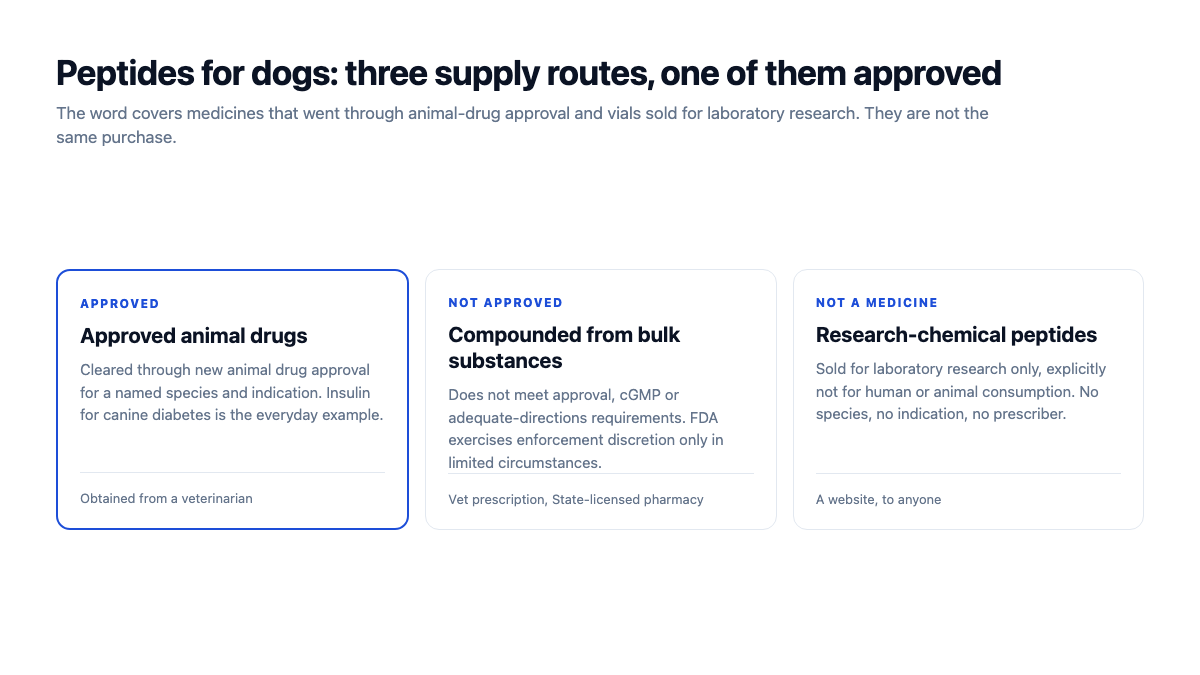
Peptides for dogs: three supply routes that are not interchangeable
Establish which lane a product is in first, because that determines what evidence sits behind it and who is accountable if it goes wrong.
| Route | Regulatory status | Who supplies it |
|---|---|---|
| Approved animal drug | Passed new animal drug approval. Safety and effectiveness reviewed for a named species and a named indication. | A veterinarian, or a pharmacy on prescription |
| Compounded from a bulk drug substance | Not approved. FDA describes limited circumstances in which it does not generally intend to take enforcement action. | A State-licensed pharmacy or veterinarian, on a valid prescription |
| Research chemical peptide | No approval and no review of any kind. Sold under a label reading for laboratory research use only, not for human or animal consumption. | A website, to anyone |
Notice what the third row says on its own label. The disclaimer that lets a research peptide be sold without a marketing authorisation is the same sentence that excludes animal use, and it is printed on the vial: the vendor stating in writing that no evaluation for use in a living animal has been done. Our primer on what research peptides actually are sets out how that category came to exist.
The middle lane is real, and it runs through a veterinarian
The compounding lane is the one most often described loosely, so quote the source. FDA guidance for industry #256, Compounding Animal Drugs from Bulk Drug Substances, docket FDA-2018-D-4533, issued by the Center for Veterinary Medicine, states:
“Animal drugs that are compounded from bulk drug substances do not meet the FD&C Act’s new animal drug approval, cGMP, or adequate directions for use requirements. However, FDA has generally exercised enforcement discretion with regard to animal drug compounding from bulk drug substances under certain circumstances.”
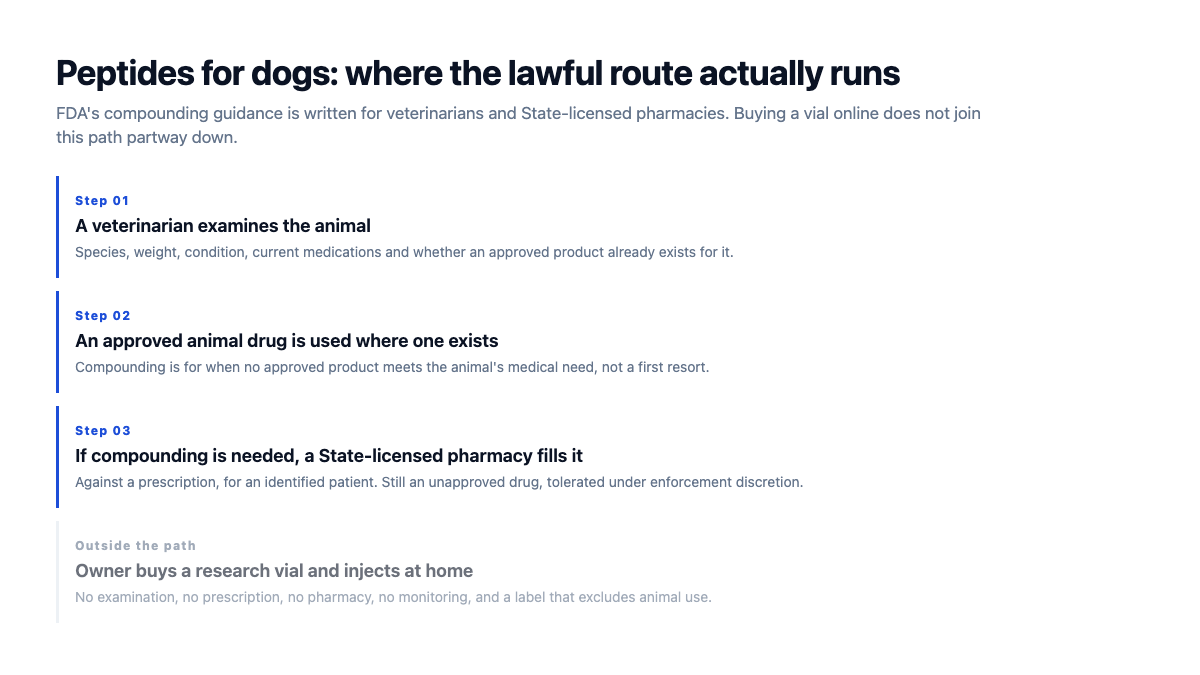
Two things follow, and both matter more than the quote itself. First, the guidance is addressed to veterinarians, State-licensed pharmacies and Federal facilities, so it describes conduct inside a prescribing relationship. An owner buying a vial from a research peptide site is not inside the circumstances FDA is describing, and nothing in that policy reaches them. Second, enforcement discretion is conditional and revocable. FDA frames it against its current understanding of the risks, so it can narrow when that understanding changes. It is not approval, and it was never permanent.
The lane is easy to confuse with the third one because both produce the same physical object, a vial of a peptide. What differs is everything around it: a veterinarian who has examined the animal, a diagnosis, a prescription, an inspectable pharmacy, and a record that exists if something goes wrong.
Grading the evidence base: five categories, one of them empty
Take BPC-157, the compound that dominates this search, and sort what exists behind it by what each tier can support.
| Category | What exists | What it can support |
|---|---|---|
| In vitro and rodent | A large body of rat and mouse work on tendon, gut and wound models | A hypothesis worth testing. Not a treatment decision. |
| Human data | Sparse. FDA reports no or only limited safety information. | Nothing about dogs. A different species, its own open questions. |
| Canine pharmacokinetics | A 2022 study measured absorption, distribution, metabolism and excretion in beagle dogs alongside rats | What a dog’s body does to the molecule. Not what the molecule does for a sick dog. |
| Veterinary anecdote | Case reports and practitioner accounts, some describing benefit and some describing none | A reason to run a trial. Uncontrolled, unblinded and unmeasured. |
| Controlled canine trials | Empty. No published randomised, blinded, placebo-controlled efficacy trial. | Nothing, because nothing is there. |
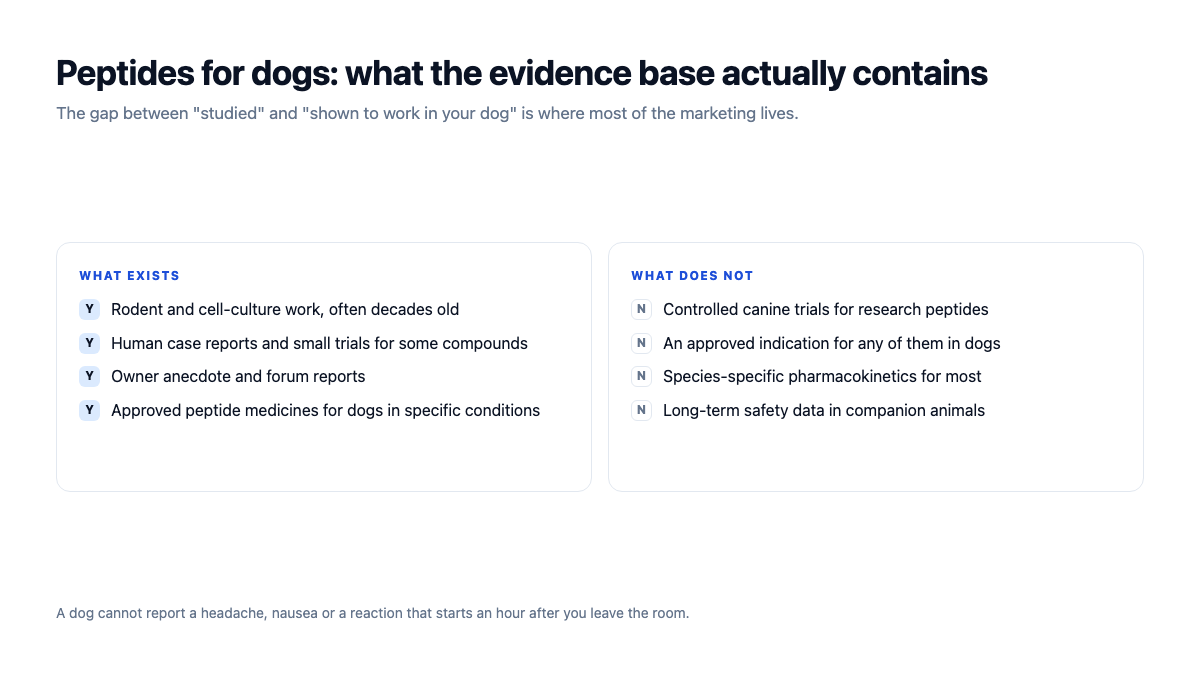
The third row is the one usually mistaken for the fifth. Canine pharmacokinetic data is real science answering a different question: it tells you the molecule is absorbed and cleared in a dog. Whether an arthritic dog walks better afterwards is something only a controlled trial with a measured endpoint can establish.
Note where the regulator sits even on the human side, where far more data exists. FDA lists BPC-157 among bulk drug substances that may present significant safety risks in compounding, citing potential immunogenicity for certain routes, complexities in peptide-related impurities and active ingredient characterisation, and no or only limited safety-related information for the proposed routes. If that is the human file, the canine file is thinner still.
You can check this rather than take it on trust. The AVMA Veterinary Clinical Trials Registry, formerly the Animal Health Studies Database, is free to search and lists prospective veterinary studies recruiting in the United States and Canada. A compound name there, alongside the indexed literature, settles the question quickly. Our guide to evaluating peptide information sources sets out the same audit for websites. For a fuller compound-by-compound breakdown of what is discussed in this space, PeptideDeck’s reference page on peptides for dogs goes into more detail than a single evidence review can.
Why cross-species extrapolation fails, in one measured figure
The temptation with an unstudied species is to take a figure from a studied one and adjust it. The same BPC-157 study shows why that fails, using two standard preclinical models. Absolute bioavailability after intramuscular injection was roughly 14 to 19 percent in rats and 45 to 51 percent in beagle dogs. Same molecule, same route, and about a threefold difference in the fraction reaching the bloodstream at all.
Nothing in the rat data predicted that gap. It had to be measured in dogs, and anyone converting a rodent figure by arithmetic would have been wrong by a wide margin with no way to know it. This is the general case rather than a quirk: a review of canine and human physiological factors by Martinez and colleagues catalogues differences in gastric emptying, intestinal transit, bile salt composition and cytochrome P450 isoform activity that shift drug exposure between species in directions nobody can predict in advance. Our guide to peptide bioavailability covers the mechanics of why so little of an administered peptide typically arrives intact.
Two further points sharpen this. The same study found the parent molecule’s elimination half-life was under thirty minutes in both species, a fact about clearance rather than a schedule, and one that any claim of a sustained effect has to explain rather than assume. And BPC-157 is the best-characterised case: for most research peptides there is no canine pharmacokinetic data at all, so the extrapolation has no measured endpoint on either side.
The feedback channel a dog does not have
An adult who takes an unstudied compound is running an uncontrolled experiment, but they are at least the instrument as well as the subject. They notice nausea, a headache, a strange feeling in a joint, and they can stop. A dog cannot do any of that, which removes an entire channel of information. The substitute is worse than most owners realise.
Veterinary medicine has built proxy instruments for exactly this problem. The Canine Brief Pain Inventory, adapted from a human questionnaire and validated by Brown and colleagues, asks the owner to score severity and interference with normal activity. It is properly validated, and it is still a person reporting on an animal.
How well does that channel perform? Conzemius and Evans tested it using the placebo arm of an approved study: fifty-eight dogs with lameness from osteoarthritis, all on placebo, assessed both subjectively and by force platform gait analysis. Owners judged their dog improved 39.7 percent of the time. Veterinarians recorded improvement 44.8 percent of the time examining dogs at a walk or trot and 43.1 percent on joint palpation. The force plate, which measures ground reaction force rather than opinion, showed no change in forty-six of the fifty-eight dogs.
Read that as an instrument specification. When nothing is happening, an owner watching at home sees improvement about two times in five, and a trained veterinarian examining the animal does no better. That is the least reliable measurement in the chain, and outside a clinic it is the only one available.
Sterility and endotoxin matter more in a small animal, not less
This site normally spends its time reading certificates of analysis, so be precise about what a good one establishes here. A complete certificate reports identity confirmation, purity against a stated specification, a bacterial endotoxins test by kinetic chromogenic LAL to USP Chapter 85 against a stated limit in endotoxin units per millilitre, a sterility screen showing no growth, and a heavy metals screen. Each rules out a specific failure mode in one batch.
What none of them establishes is anything at all about a dog. Purity states what fraction of the powder is the intended molecule, not whether that molecule helps an arthritic hip. A sterility result describes a sealed vial at the moment of testing, not one reconstituted on a kitchen counter and drawn from repeatedly over days. And an endotoxin result under a stated limit means contamination in that lot fell below a threshold, where the thresholds regulators use are set per unit of bodyweight. That is exactly why a smaller animal has less headroom for the same contamination than an adult human does.
Two consequences follow. Testing scope is a property of the batch, not the product: from one supplier, a lot certificate may carry endotoxin and sterility screens while another, for a different compound, reports neither. Reading the certificate attached to the lot in your hand is the only version of that check worth anything. And the clinical observation that would catch an early reaction does not exist at home. The animal that cannot report a reaction is also the one least likely to be watched by anybody qualified to recognise it.
Five questions for a veterinarian, none of them about a dose
Everything above converges on the same place, and it is not a disclaimer bolted to the end. Where the evidence that would justify a decision does not exist, the move is not to find a smaller number. It is to hand the decision to someone who can examine the animal, order a measurement, and be accountable for the outcome.
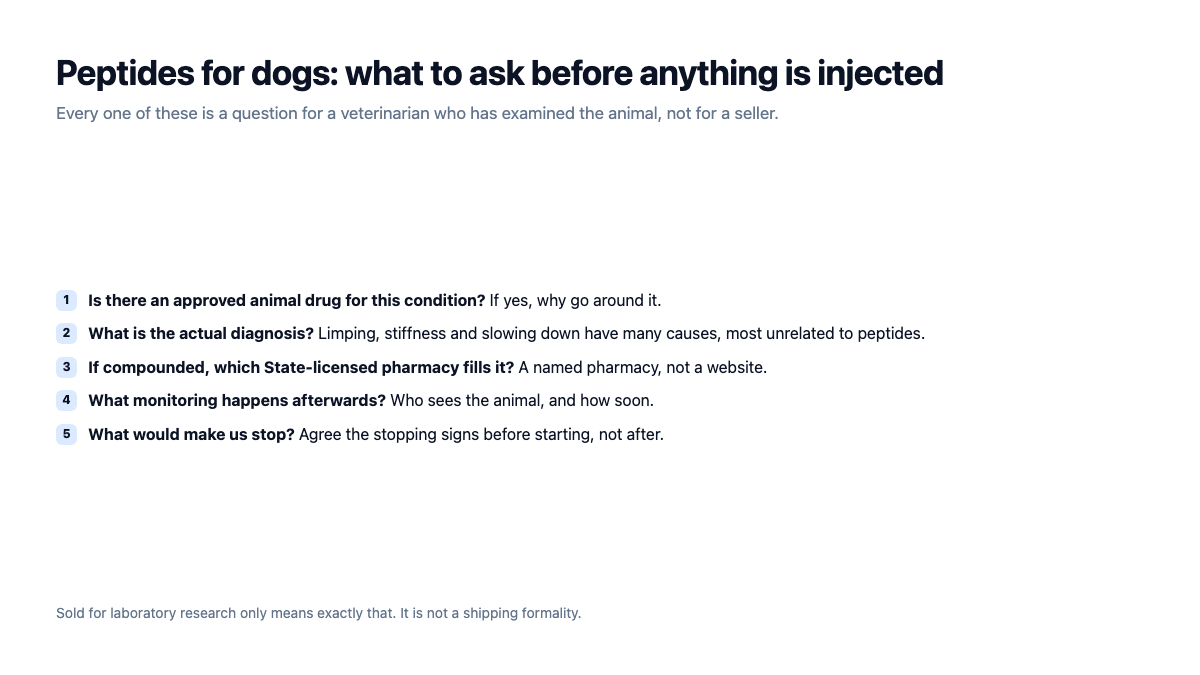
- What is the diagnosis, and how was it established? A peptide is a proposed answer, so it is worth knowing the question first.
- Is there an approved animal drug for this indication in this species? If one exists, it carries a review that nothing in the other two lanes does.
- If a compounded preparation is proposed, which State-licensed pharmacy will prepare it, and what does the prescription say? That places the treatment inside or outside the lawful pathway, and you are entitled to know which.
- What would count as evidence that this is working, and how will it be measured rather than observed? Given how home assessment performs against a force plate, the answer should be more objective than watching.
- What are the early signs this should stop, who monitors for them, and what happens out of hours? A dog will not raise the alarm, so the monitoring plan has to.
None of this makes research peptides uninteresting. The rodent work is real, the canine pharmacokinetic data is real, and the mechanistic case for several of these compounds is not absurd. What is missing is the study that would turn any of it into a treatment decision for a particular animal. Until it exists, the honest grade for peptides for dogs outside the approved and prescribed lanes is not negative. It is incomplete, and incomplete is not something an owner can safely round up.
Frequently asked questions
- Are peptides FDA approved for dogs?
- Some are. Insulin is a peptide, and Merck Animal Health describes Vetsulin (porcine insulin zinc suspension) as the first veterinary insulin FDA-approved for both dogs and cats with diabetes mellitus. So the common claim that peptides are unapproved for dogs is wrong. The accurate version is narrower: some are approved, and none of the peptides sold as research chemicals are among them.
- Is there a controlled clinical trial of BPC-157 in dogs?
- Not a published controlled efficacy trial, which is the thing an owner would actually need. Canine pharmacokinetic work does exist: a 2022 study in Frontiers in Pharmacology measured absorption, distribution, metabolism and excretion in beagle dogs. That establishes what a dog's body does to the molecule, not whether the molecule helps a sick dog.
- Can human or rodent peptide research be scaled to a dog?
- Not reliably. In the same BPC-157 study, absolute bioavailability after intramuscular injection was roughly 14 to 19 percent in rats but 45 to 51 percent in beagle dogs. Same molecule, same route, a threefold difference in the fraction reaching the bloodstream, and nothing in the rat data predicted it. Species differences have to be measured, not calculated.
- Does a certificate of analysis make a research peptide safe for a dog?
- No. A certificate establishes what is in a vial: identity, purity against a specification, endotoxin below a stated limit by a bacterial endotoxins test to USP Chapter 85, a sterility screen, and a heavy metals screen. Every one is a statement about the chemistry of one batch. None says whether the substance helps or harms a dog, and none survives reconstitution and handling outside a laboratory. Testing scope also varies by lot rather than by product.
- What is the lawful route for a dog to receive a compounded peptide?
- Through a veterinarian who has examined the animal, and a State-licensed pharmacy or veterinarian compounding under a valid prescription. FDA guidance for industry #256 describes circumstances in which the agency does not generally intend to take enforcement action, and it is written for veterinarians, State-licensed pharmacies and Federal facilities. An owner buying a vial from a website is not on that pathway, and enforcement discretion is not approval.
- Why does this article refuse to publish a dose for dogs?
- Because a number implies a validation exercise that has not happened. A dose is defensible when a study established it in the species being treated, using an endpoint that was measured rather than observed. For research peptides in dogs that study does not exist, so any figure in circulation is an extrapolation wearing the confidence of a prescription. A dog also cannot report an early reaction, so whoever acted on the number would be the last to know it was wrong.
Limitations of the evidence
This article grades an evidence base. It does not recommend, endorse or describe giving any peptide to any animal, and it deliberately contains no dosing information. It cannot tell you whether a peptide would help your dog, because for every research peptide discussed here the study that would answer that has not been run. The absence of controlled canine efficacy trials is an absence in the published record as of the review date above, found by searching indexed literature and the AVMA registry; unpublished, industry-held or newly registered work would not appear there. The compounding policy described is guidance rather than statute, FDA states it reflects the agency's current understanding of the risks, and the lists it references are revised periodically, so both should be re-checked. Nothing here is veterinary advice or a substitute for an examination, diagnosis and prescription from a veterinarian who has seen the animal.
References
Citations are annotated with an evidence tier reflecting study design and replication. See Methodology for criteria.
- 1.U.S. Food and Drug Administration, Center for Veterinary Medicine · CVM GFI #256, Compounding Animal Drugs from Bulk Drug Substances, docket FDA-2018-D-4533 · 2022Validated
- 2.U.S. Food and Drug Administration, Center for Veterinary Medicine · Questions and Answers on GFI #256, Compounding Animal Drugs from Bulk Drug Substances · 2026Validated
- 3.Merck Animal Health · About Vetsulin (porcine insulin zinc suspension): the first veterinary insulin FDA-approved for both dogs and cats · 2026Validated
- 4.He L, Feng D, Guo H, Zhou Y, Li Z, Zhang K, Zhang W, Wang S, et al. · Pharmacokinetics, distribution, metabolism, and excretion of body-protective compound 157, a potential drug for treating various wounds, in rats and dogs · Frontiers in Pharmacology · 2022PMID 36588717DOI 10.3389/fphar.2022.1026182Preclinical
- 5.Martinez MN, Mochel JP, Neuhoff S, Pade D. · Comparison of Canine and Human Physiological Factors: Understanding Interspecies Differences that Impact Drug Pharmacokinetics · The AAPS Journal · 2021DOI 10.1208/s12248-021-00590-0Validated
- 6.Conzemius MG, Evans RB. · Caregiver placebo effect for dogs with lameness from osteoarthritis · Journal of the American Veterinary Medical Association · 2012PMID 23113523DOI 10.2460/javma.241.10.1314Validated
- 7.Brown DC, Boston RC, Coyne JC, Farrar JT. · Ability of the Canine Brief Pain Inventory to detect response to treatment in dogs with osteoarthritis · Journal of the American Veterinary Medical Association · 2008PMID 19180716DOI 10.2460/javma.233.8.1278Validated
- 8.U.S. Food and Drug Administration · Certain Bulk Drug Substances for Use in Compounding That May Present Significant Safety Risks · 2026Validated
- 9.American Veterinary Medical Association · AVMA Veterinary Clinical Trials Registry, formerly the Animal Health Studies Database · 2026Validated