Foundational guide
Peptide Calculator: Concentration, Dose Accuracy and What a U-100 Syringe Can Actually Deliver
The arithmetic behind reconstitution is three divisions and it is never the hard part. This guide sets out the formulas, works every figure through in full, and then examines where measurement error genuinely enters: the diluent volume, the syringe graduation, and the label mass itself.
The short answer
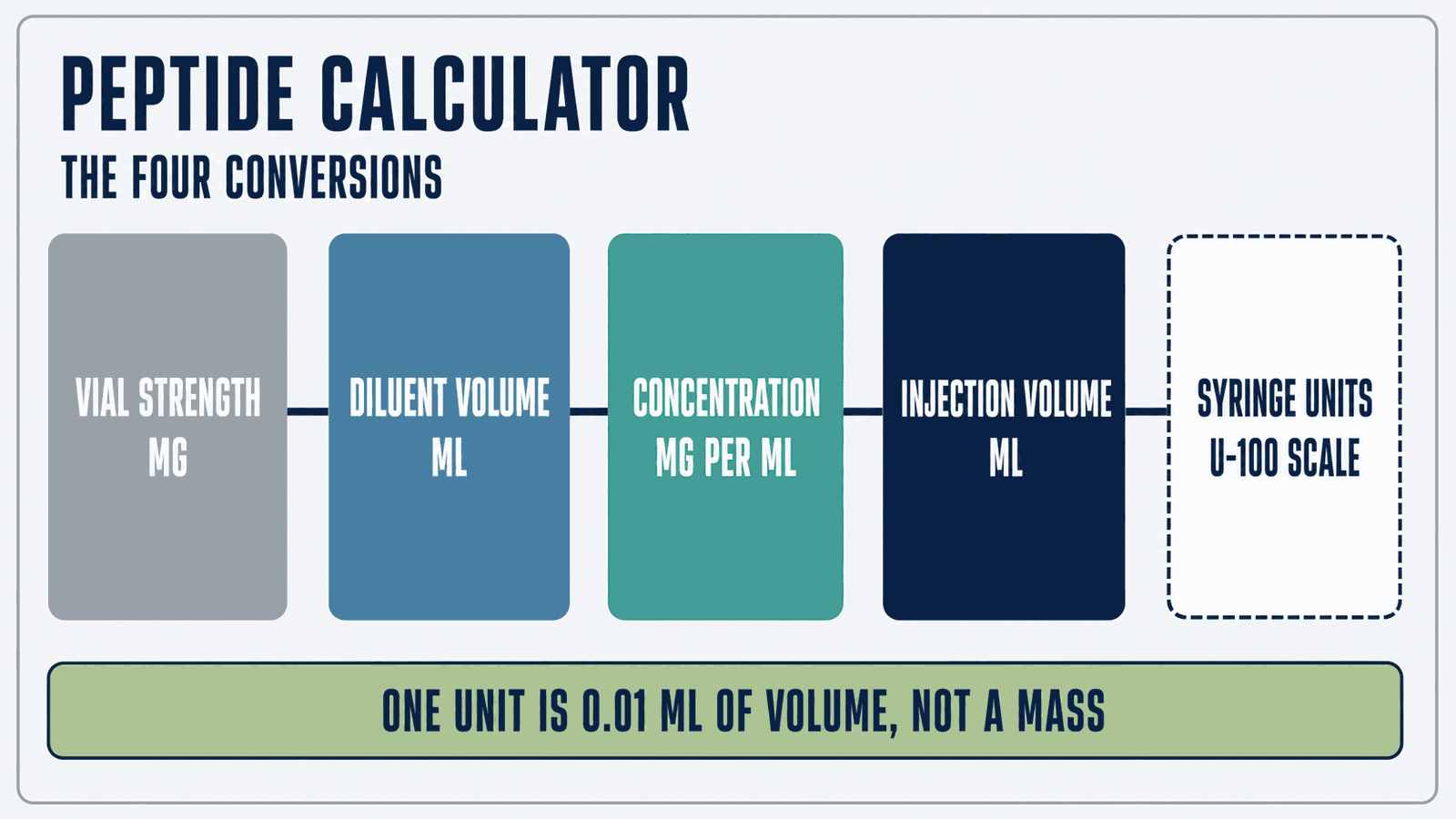
A peptide calculator converts three known quantities into a syringe reading. Vial strength in milligrams divided by diluent volume in millilitres gives concentration in mg/mL. The prescribed dose in milligrams divided by that concentration gives injection volume in millilitres. Multiplying that volume by 100 gives units on a U-100 syringe, because one unit is 0.01 mL.
Everything difficult about peptide dosing lies on either side of that arithmetic. The division itself is exact and cannot be improved on. What can go wrong is the quality of the three numbers entering it, and the precision of the instrument used to act on the answer. This guide works through the arithmetic in full, then treats the measurement problem properly.
What does a peptide calculator compute?
A peptide calculator is a reconstitution and dose-conversion tool. It takes a lyophilised vial of known labelled strength, a stated volume of bacteriostatic water, a target dose, and a syringe barrel, and it returns four quantities: the concentration of the reconstituted solution, the injection volume for one dose, the number of doses the vial contains, and the mark to draw to on a U-100 scale. Those four outputs follow from three formulas and one definition.
concentration (mg/mL) = vial strength (mg) ÷ diluent volume (mL)
injection volume (mL) = dose (mg) ÷ concentration (mg/mL)
U-100 units = injection volume (mL) × 100
doses per vial = vial strength (mg) ÷ dose (mg)
1 mg = 1000 mcg
Doing this by hand is error-prone in a specific and predictable way: the dose is usually quoted in micrograms while the vial is labelled in milligrams, and the factor of 1000 between them is the most frequently dropped step in the whole calculation. PeptideDeck publishes a free peptide calculator that performs all four conversions at once from vial size, bacteriostatic water volume, desired dose in mcg or mg, and syringe barrel, and it displays the resulting draw mark on a U-100 scale rather than leaving you to convert a volume into a graduation yourself. It carries presets for BPC-157, TB-500, CJC-1295 (No DAC), Ipamorelin, Retatrutide, GHK-Cu, MOTS-c and Semax, and separate half-life and microdosing-schedule modes.
What no calculator does is measure anything. It is an arithmetic engine operating on numbers you supply. If the vial contains less peptide than the label states, or you added 2.3 mL of diluent while entering 2.0, the output will be internally consistent and externally wrong, and nothing in the tool can detect that. This is worth stating plainly at the outset, because the rest of this guide is about the distance between an exact calculation and an accurate dose.
Why does reconstitution volume not change the amount of drug in the vial?
This is the single most misunderstood point in peptide reconstitution, and it is settled by conservation of mass rather than by opinion. The quantity of peptide in a lyophilised vial is fixed when the vial is filled and sealed. Bacteriostatic water is a solvent. It contributes volume and contributes no peptide. Adding 1 mL or 5 mL to the same 5 mg vial produces two solutions of different concentration containing identical total mass.
The consequence is visible directly in the formulas. Concentration, injection volume and unit count all contain the diluent volume term and all change when it changes. Doses per vial does not contain it:
doses per vial = vial strength (mg) ÷ dose (mg)
no diluent term appears, therefore the value is invariant under dilution
The same conclusion arrives by a second route, which is a useful check because it uses entirely different quantities. Doses per vial can also be computed as the total solution volume divided by the injection volume. Diluting more increases the numerator and increases the denominator by exactly the same factor, so the ratio is unchanged. Both routes must agree, and in the table below they do, row by row.
| BAC water added | Concentration | Volume for a 250 mcg dose | U-100 units | Doses per vial |
|---|---|---|---|---|
| 1 mL | 5 mg/mL | 0.05 mL | 5 | 20 |
| 2 mL | 2.5 mg/mL | 0.1 mL | 10 | 20 |
| 3 mL | 1.6667 mg/mL | 0.15 mL | 15 | 20 |
| 5 mL | 1 mg/mL | 0.25 mL | 25 | 20 |
All four rows: 5 mg vial, 250 mcg (0.25 mg) dose. Doses per vial = 5 ÷ 0.25 = 20 in every case. The third row is worth reading twice: the concentration 5 ÷ 3 is a recurring decimal, yet the injection volume 0.25 ÷ (5/3) = 0.15 mL is exact. Rounding the concentration to 1.67 and then dividing would have introduced an error that the exact fraction does not.
Two corollaries follow. First, a vial cannot be made to go further by adding less water, nor wasted by adding more. Second, and less obviously, dilution is not neutral either: it determines how finely the fixed mass can be subdivided by the syringe. That is the real decision being made at reconstitution, and it is the subject of the resolution section below.
How do you calculate peptide dosage? Ten worked examples
Every row below applies the same three steps to a different combination of vial strength, diluent volume and dose, and every figure has been recomputed in exact rational arithmetic rather than rounded decimals. Concentration is vial strength divided by diluent volume. Injection volume is dose divided by concentration. Units are injection volume times 100. Doses per vial is vial strength divided by dose. The dose column assumes a figure set by a prescribing clinician or a stated research protocol; this table converts it, it does not recommend it.
| Vial strength | BAC water | Concentration mg ÷ mL | Dose | Injection volume dose ÷ conc. | U-100 units mL × 100 | Doses per vial |
|---|---|---|---|---|---|---|
| 5 mg | 1 mL | 5 mg/mL | 250 mcg | 0.05 mL | 5 | 20 |
| 5 mg | 2 mL | 2.5 mg/mL | 250 mcg | 0.1 mL | 10 | 20 |
| 5 mg | 3 mL | 1.6667 mg/mL | 250 mcg | 0.15 mL | 15 | 20 |
| 5 mg | 5 mL | 1 mg/mL | 250 mcg | 0.25 mL | 25 | 20 |
| 10 mg | 2 mL | 5 mg/mL | 500 mcg | 0.1 mL | 10 | 20 |
| 10 mg | 5 mL | 2 mg/mL | 500 mcg | 0.25 mL | 25 | 20 |
| 15 mg | 3 mL | 5 mg/mL | 1 mg | 0.2 mL | 20 | 15 |
| 30 mg | 3 mL | 10 mg/mL | 2.5 mg | 0.25 mL | 25 | 12 |
| 50 mg | 2 mL | 25 mg/mL | 5 mg | 0.2 mL | 20 | 10 |
| 100 mg | 5 mL | 20 mg/mL | 2 mg | 0.1 mL | 10 | 50 |
Two independent checks were applied to every row. Units × 0.01 mL × concentration must return the dose, and doses per vial × dose must return the vial strength. Both hold exactly in all ten rows. A third check, diluent volume ÷ injection volume, reproduces the doses per vial column independently.
Row three deserves a note. The concentration 1.6667 mg/mL is shown rounded to four decimal places, but it is exactly 5/3, and the injection volume was computed from the exact fraction. Working from the rounded figure gives 0.25 ÷ 1.6667 = 0.149997 mL, which rounds back to 0.15 mL and is harmless here, but the habit of rounding an intermediate result before dividing by it is one of the ways hand calculations drift. Carry the fraction, round only the answer.
What is a unit on a U-100 syringe?
A unit on a U-100 insulin syringe is a volume graduation equal to 0.01 mL. It is not a milligram, not a microgram, and for any compound other than insulin it is not an international unit of anything. This is the single most consequential misunderstanding in peptide dose arithmetic, and correcting it removes an entire category of error.
The designation comes from insulin labelling. U-100 means a solution containing 100 international units of insulin per millilitre, and ISO 8537 specifies insulin syringes for use with both U-40 and U-100 concentrations.[1] Because the syringe is scaled to that concentration, one graduation on a U-100 barrel corresponds to one international unit of U-100 insulin and simultaneously to 0.01 mL of liquid. For insulin at that strength the two readings coincide, which is precisely why the distinction is easy to lose.
For a reconstituted research peptide the coincidence does not exist. The barrel has no knowledge of what is inside it. It is a volumetric ruler, and the mass it delivers is whatever the concentration puts into that volume:
mass in one unit (mg) = concentration (mg/mL) × 0.01 mL
mass in one unit (mcg) = concentration (mg/mL) × 10
So one unit carries 25 mcg from a 2.5 mg/mL solution, 50 mcg from a 5 mg/mL solution, and 100 mcg from a 10 mg/mL solution. Two syringes drawn to the same 10-unit mark from two differently reconstituted vials of the same peptide contain the same volume and different masses. Confusion between unit markings and volume markings is a documented and recurring class of medication error in clinical insulin practice, where dose orders are recommended to specify units and volume together for exactly this reason.[2]
The practical rule that follows is short. A unit count is meaningless unless the concentration it was derived from travels with it. Recording “10 units” on a vial label is not a record of a dose. Recording “2.5 mg/mL, 250 mcg = 10 units” is.
How many units is 250 mcg?
As posed, this question is unanswerable, and recognising why is more useful than any single number. Units measure volume and micrograms measure mass. Converting between them requires a concentration, and until one is supplied the question has no unique answer. On a U-100 syringe, a 250 mcg dose is:
- 25 units at 1 mg/mL, because 0.25 mg ÷ 1 mg/mL = 0.25 mL
- 15 units at 1.6667 mg/mL, because 0.25 mg ÷ (5/3) mg/mL = 0.15 mL
- 10 units at 2.5 mg/mL, because 0.25 mg ÷ 2.5 mg/mL = 0.1 mL
- 5 units at 5 mg/mL, because 0.25 mg ÷ 5 mg/mL = 0.05 mL
All four are correct answers to four different questions. The well-formed version of the question always names the concentration or the two numbers that determine it: “how many units is 250 mcg from a 5 mg vial reconstituted with 2 mL?” That version has exactly one answer, which is 10 units. Any dosing instruction, note or spreadsheet that records a unit count without the concentration beside it has discarded the information needed to reconstruct the dose.
How much BAC water should I use?
Since the diluent volume cannot change the total mass in the vial or the number of doses it yields, choosing it is not a dosing decision. It is a decision about measurement resolution. A more dilute solution spreads the same fixed mass across more syringe graduations, so each graduation carries less drug and the smallest change you can make to a dose becomes smaller.
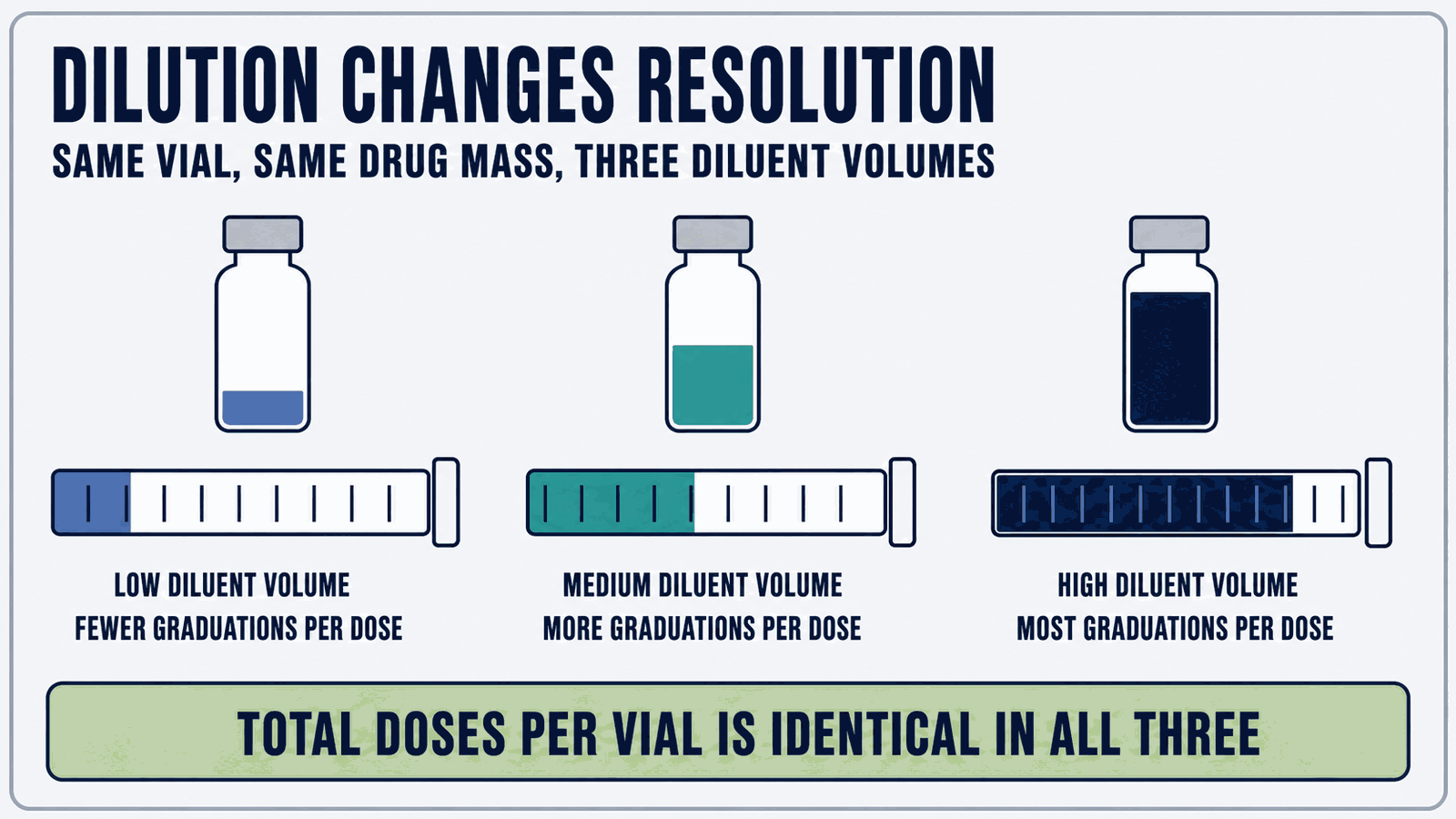
The table below quantifies that. Each row holds the same 250 mcg target dose and varies only the concentration, showing what a single graduation is worth in each case.
| Concentration | Mass in 1 unit 0.01 mL | 250 mcg as volume | 250 mcg as units | 1 unit as share of dose |
|---|---|---|---|---|
| 1 mg/mL | 10 mcg | 0.25 mL | 25 | 4% |
| 2 mg/mL | 20 mcg | 0.125 mL | 12.5 (not a whole graduation) | 8% |
| 2.5 mg/mL | 25 mcg | 0.1 mL | 10 | 10% |
| 5 mg/mL | 50 mcg | 0.05 mL | 5 | 20% |
| 10 mg/mL | 100 mcg | 0.025 mL | 2.5 (not a whole graduation) | 40% |
| 20 mg/mL | 200 mcg | 0.0125 mL | 1.25 (not a whole graduation) | 80% |
Every row verified as concentration × 10 = mcg per unit, and 250 mcg ÷ (concentration × 10) = the unit count. At 20 mg/mL the entire dose occupies just over one graduation, which is a resolution failure rather than a dosing choice.
The useful move is to run the arithmetic backwards. Decide what unit count you want the dose to land on, then solve for the diluent volume that produces it:
required concentration (mg/mL) = dose (mg) ÷ (target units ÷ 100)
diluent volume (mL) = vial strength (mg) ÷ required concentration (mg/mL)
To place a 250 mcg dose on exactly 10 units: 0.25 mg ÷ 0.1 mL = 2.5 mg/mL, so a 5 mg vial takes 2 mL, a 10 mg vial takes 4 mL, and a 15 mg vial takes 6 mL. To place a 1 mg dose on 20 units: 1 mg ÷ 0.2 mL = 5 mg/mL, so a 10 mg vial takes 2 mL and a 30 mg vial takes 6 mL. Each of these reproduces the original target exactly when pushed back through the forward formulas.
Two constraints bound the choice from above. Barrel capacity in units is simply barrel volume in millilitres times 100, so a 1 mL barrel spans 100 units and a half-millilitre barrel spans 50; the injection volume must fit inside it, which caps how dilute the solution can usefully be. And a larger diluent volume means a larger volume of solution sitting in the vial for the life of the compound, which is a stability and sterility consideration rather than an arithmetic one and sits outside the scope of this guide.
Where does measurement error actually enter?
The calculation returns an exact answer, so any discrepancy between the intended dose and the delivered dose originates in the physical quantities, not in the arithmetic. Treating this as a measurement problem, the delivered mass is a product and a quotient of three measured quantities, and for small errors the relative uncertainties combine additively, the standard first-order treatment in metrology.[3],[4]
delivered mass = (vial mass ÷ diluent volume) × volume drawn
relative error ≈ (error in vial mass) − (error in diluent volume) + (error in volume drawn)
The minus sign on the middle term is not a typographical accident, and it is the source of a result most people find counterintuitive. Diluent volume sits in a denominator, so adding too much water lowers the delivered dose, and it does so by less than the proportion you overshot by.
Source one: the diluent volume, a systematic error across the whole vial
Suppose the intent is 5 mg in 2 mL, giving 2.5 mg/mL, with 250 mcg drawn as 0.1 mL, or 10 units. Suppose 2.2 mL is actually added, a 10 percent overshoot that is easy to produce when measuring a small volume with a 3 mL syringe. The true concentration becomes 5 ÷ 2.2 = 2.2727 mg/mL. Drawing the same 0.1 mL now delivers 0.22727 mg, which is 227.27 mcg rather than 250, a shortfall of 9.09 percent.
The shortfall is 9.09 percent and not 10 because the relationship is reciprocal: 1 ÷ 1.1 = 0.9091. The general form is that a diluent error of +5, +10 or +20 percent produces a dose error of −4.76, −9.09 or −16.67 percent respectively, while −5 or −10 percent produces +5.26 or +11.11 percent. Under-adding diluent is the more dangerous direction, because the resulting overdose exceeds the size of the volumetric mistake.
Mass conservation supplies an elegant check on the whole picture. In the 2.2 mL vial, 2.2 ÷ 0.1 gives 22 available draws of 227.27 mcg each, and 22 × 227.27 mcg = 5000 mcg = 5 mg. In the intended 2 mL vial, 20 draws of 250 mcg also total 5 mg. The diluent error did not destroy or create drug. It redistributed the same fixed mass across more draws, which is exactly the invariance established earlier, now seen through a mistake.
The critical property of this error is that it is systematic. It is fixed at the moment of reconstitution and it applies identically to every dose taken from that vial for as long as the vial lasts. It cannot be averaged out and it cannot be noticed from the syringe.
Source two: the syringe reading, a random error per dose
Misreading the barrel by one graduation is a different kind of error: it varies dose to dose rather than persisting. Its relative size has a clean closed form. Drawing one graduation too many adds 0.01 mL to an intended volume of u × 0.01 mL, so the relative error is exactly 1/u, where u is the target unit count.
relative error of a one-graduation slip = 1 ÷ (target units)
At a 5-unit target that is 20 percent. At 10 units, 10 percent. At 15 units, 6.67 percent. At 20 units, 5 percent. At 25 units, 4 percent. Verifying the first two directly against the concentrations that produce them: 5 mg in 1 mL gives 5 mg/mL, where 250 mcg is 5 units and 6 units delivers 0.06 mL × 5 mg/mL = 300 mcg, a 20 percent overshoot; 5 mg in 2 mL gives 2.5 mg/mL, where 250 mcg is 10 units and 11 units delivers 0.11 mL × 2.5 mg/mL = 275 mcg, a 10 percent overshoot.
This is the quantitative argument behind the resolution table. The same physical slip of the plunger costs twice as much dose accuracy at 5 mg/mL as at 2.5 mg/mL, not because the hand was less steady but because the dose occupied half as many graduations. Reconstituting to a larger volume buys precision against this error class, up to the limit imposed by barrel capacity.
Source three: the labelled mass, an error you cannot see
The first term in the propagation expression is the one nobody doing the arithmetic can evaluate. Every calculation on this page begins by trusting that the vial contains the mass printed on it. That trust is an assumption about manufacturing and analysis, not a measurement, and no amount of care with a syringe can compensate for it being wrong. It is the reason a certificate of analysis, and the identity and purity assays behind it, matter more to real dose accuracy than any refinement of the arithmetic.
What can a U-100 syringe not deliver?
A U-100 insulin syringe is a precise instrument within a narrow envelope, and being clear about the envelope prevents a calculated figure from being mistaken for an achievable one. Four limits apply.
- It cannot resolve below one graduation. Calculated volumes of 0.125 mL, 0.025 mL and 0.0125 mL correspond to 12.5, 2.5 and 1.25 units. A calculator will return those numbers because the arithmetic is valid, but the barrel cannot be read to a quarter or a half of a mark with any reliability. When a calculation lands on a fractional unit, the correct response is to change the reconstitution volume so it lands on a whole one, not to estimate between marks.
- It cannot exceed its barrel volume. Capacity in units equals capacity in millilitres times 100, so a 1 mL barrel stops at 100 units and a half-millilitre barrel at 50. Any injection volume above that requires either a more concentrated solution or more than one draw.
- Its graduation interval is a property of the specific barrel. The spacing between printed marks differs between syringe sizes and products, and the arithmetic above assumes only the U-100 definition that one unit is 0.01 mL. Read the scale on the barrel in front of you rather than assuming the interval, because the resolution figures in the table above are per unit, and a barrel marked every two units has half the resolution they imply.
- A reading is not a guarantee of a volume. Graduations are manufactured to a stated volumetric tolerance, so drawing to the 10-unit mark delivers approximately 0.100 mL, not exactly. This is a precision floor beneath everything above it, and it is why chasing accuracy far below one graduation is not a meaningful exercise.
What the arithmetic does not capture
The formulas describe an idealised system: a known mass, dissolved completely in a known volume, drawn without loss. Four physical realities sit outside that model, and a technically exact treatment of peptide calculators has to name them rather than let the precision of the output imply a precision it does not have.
Solute displacement. Every reconstitution calculator computes concentration as mass divided by diluent volume, which quietly assumes that the final solution volume equals the volume of water added. It does not: the dissolved solid occupies space. Taking 0.735 mL/g, the average partial specific volume across known human protein sequences,[5] as an order-of-magnitude estimate, 5 mg of solid occupies about 0.0037 mL. Added to 2 mL that gives a final volume of 2.0037 mL and a true concentration of 2.4954 mg/mL against a nominal 2.5, a deviation of 0.18 percent, which is far below the resolution of any insulin syringe and safely ignorable. The picture changes at high mass loading: 100 mg of solid occupies roughly 0.0735 mL, so 100 mg in 1 mL yields about 1.0735 mL of solution at roughly 93.2 mg/mL rather than 100 mg/mL, a deviation near 6.8 percent. The convention is standard and appropriate at ordinary peptide concentrations. It is worth knowing that it is a convention.
Labelled mass versus peptide content. A vial labelled 5 mg states a mass. Depending on how the material was purified and characterised, that mass may include counterions and residual water alongside the peptide itself, so the peptide content can be lower than the gross weight. Where a supplier reports both a gross weight and a net peptide content, they are different numbers and only one of them belongs in the calculator. Where only one figure is given without saying which it is, the ambiguity propagates directly into every dose and cannot be resolved by arithmetic.
Fill volume and recoverable volume. Doses per vial is a theoretical maximum, not a count you will achieve. Liquid injectable products are filled with a deliberate excess so that the labelled volume can actually be withdrawn, and the FDA publishes guidance on how much excess is allowable and how vial fill size should be labelled.[6] Research-grade lyophilised vials carry no equivalent assurance in either direction. Residual solution in the needle hub and syringe dead space, and losses to adsorption on vial and syringe surfaces, all reduce what is recoverable. Expect the last calculated dose in a vial to be the one that does not materialise.
Time. The concentration figure describes the moment after reconstitution. It says nothing about whether the compound is still intact a month later. A calculator that also models plasma concentration over time, as the half-life mode on the tool described above does, is answering a pharmacokinetic question rather than a volumetric one, and the two should not be conflated. The elimination arithmetic itself is simple, with 50, 25, 12.5 and 6.25 percent of an amount remaining after one, two, three and four half-lives, but that is a property of the exponential model, and applying it requires a half-life value that has actually been measured in the relevant species. Our guide to peptide half-life covers where those values come from and how often they are missing, and the routes of administration guide covers why the delivered dose and the absorbed dose are not the same quantity.
The short version
Concentration is vial strength divided by diluent volume. Injection volume is dose divided by concentration. Units are injection volume times 100, because a U-100 graduation is 0.01 mL of liquid and nothing else. Doses per vial is vial strength divided by dose, and no quantity of bacteriostatic water will change it.
Reconstitution volume is therefore a resolution setting, not a dose setting. Choose it so the dose lands on a whole number of graduations well inside the barrel, record the concentration alongside every unit count, and recognise that the diluent measurement is a one-time systematic error affecting every dose from that vial while the syringe reading is a per-dose random one worth 1/u of the target. Beyond that, accuracy stops being arithmetic and becomes a question about what is actually in the vial, which is a question about sourcing and analysis. For the regulatory and evidentiary background to that question, see what research peptides actually are and our assessment of peptide information sources, which scores reference sites partly on whether their dosing figures state where they came from.
Frequently asked questions
- How do you calculate peptide dosage?
- Three divisions. Divide vial strength in milligrams by the diluent volume in millilitres to get concentration in mg/mL. Divide the dose your protocol specifies, converted to milligrams, by that concentration to get injection volume in millilitres. Multiply that volume by 100 to get units on a U-100 syringe. A 5 mg vial in 2 mL gives 2.5 mg/mL, so a 250 mcg dose is 0.1 mL, or 10 units.
- How many units is 250 mcg?
- The question has no single answer, because units measure volume rather than mass. At 1 mg/mL, 250 mcg is 0.25 mL, or 25 units. At 2.5 mg/mL it is 0.1 mL, or 10 units. At 5 mg/mL it is 0.05 mL, or 5 units. State the concentration first, or the unit count is meaningless.
- Does adding more BAC water reduce the dose?
- No. The mass of peptide in the vial is fixed at manufacture, and diluent adds none and removes none. Adding more water lowers the concentration and raises the injection volume for the same dose, and those two changes cancel exactly. Doses per vial equals vial strength divided by dose, a ratio with no diluent term in it.
- How much BAC water should I use?
- Reconstitution volume is a resolution decision, not a dose decision. Pick the volume that places your target dose on a whole number of syringe graduations, well inside the barrel. To put a 250 mcg dose on 10 units you need 2.5 mg/mL, which means 2 mL for a 5 mg vial and 4 mL for a 10 mg vial.
- Is a unit on an insulin syringe the same as a milligram?
- No, and treating it as one is the most common error in this arithmetic. A unit is a volume graduation equal to 0.01 mL, because a U-100 barrel holds 100 units per millilitre. The mass in one unit depends entirely on concentration: 25 mcg at 2.5 mg/mL, 50 mcg at 5 mg/mL, 100 mcg at 10 mg/mL.
- What happens if I add the wrong amount of BAC water?
- The error is systematic and affects every dose drawn from that vial. Adding 2.2 mL instead of 2 mL to a 5 mg vial gives 2.2727 mg/mL rather than 2.5, so a 0.1 mL draw delivers 227.27 mcg rather than 250, which is 9.09 percent low. Note the asymmetry: 10 percent extra diluent costs 9.09 percent of dose, not 10.
Limitations of the evidence
This article is arithmetic and metrology, not a protocol, and nothing in it recommends a dose, a compound or a route. Every worked example converts a dose figure that is assumed to have been set elsewhere, by a prescribing clinician or by a stated research protocol, into a syringe reading. The formulas are exact, but their output is only as good as their three inputs, and two of those inputs cannot be verified by the person doing the calculation: the mass actually present in the vial, and the true delivered volume of the syringe in hand. The displacement estimate in the final section uses a partial specific volume averaged across human protein sequences rather than a measured value for any particular peptide, so it indicates a magnitude and should not be treated as a correction factor. Graduation intervals, barrel capacities and volumetric tolerances vary between syringe products; the figures here follow from the U-100 definition of one unit as 0.01 mL and from the barrel volume, and the barrel actually in use should be read rather than assumed. Research peptides are supplied for laboratory research use, most have no approved human dosing standard, and the existence of an arithmetic answer is not evidence that any particular dose is appropriate or safe.
References
Citations are annotated with an evidence tier reflecting study design and replication. See Methodology for criteria.
- 1.International Organization for Standardization · ISO 8537:2016, Sterile single-use syringes, with or without needle, for insulin · ISO · 2016Validated
- 2.Institute for Safe Medication Practices · ISMP Guidelines for Optimizing Safe Subcutaneous Insulin Use in Adults · 2018Validated
- 3.Joint Committee for Guides in Metrology · JCGM 100:2008, Evaluation of measurement data: Guide to the expression of uncertainty in measurement · Bureau International des Poids et Mesures · 2008Validated
- 4.Taylor BN, Kuyatt CE. · NIST Technical Note 1297: Guidelines for Evaluating and Expressing the Uncertainty of NIST Measurement Results · National Institute of Standards and Technology · 1994Validated
- 5.Brown PH, Balbo A, Zhao H, Ebel C, Schuck P. · Density contrast sedimentation velocity for the determination of protein partial-specific volumes · PLoS One · 2011PMID 22028836DOI 10.1371/journal.pone.0026221Validated
- 6.U.S. Food and Drug Administration · Allowable Excess Volume and Labeled Vial Fill Size in Injectable Drug and Biological Products: Guidance for Industry · 2015Validated